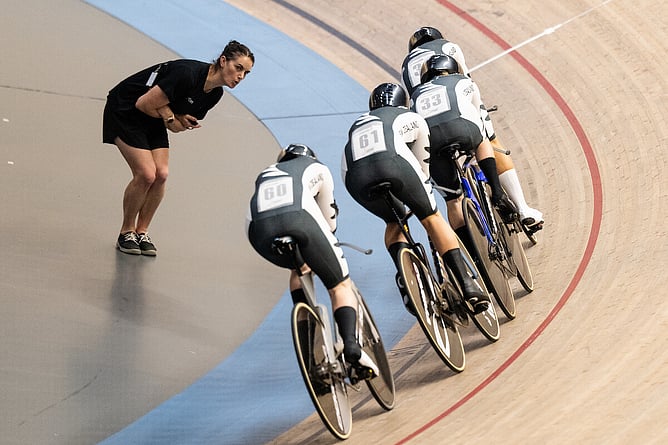
The 13-strong Cycling New Zealand team returned home much richer for the experience at the UCI Junior Track World Championships in Europe.
The squad, after months of preparation in their home venues and a camp at the Grassroots Trust Velodrome in Cambridge, took on the might of the rest of the world at the superb Heusden-Zolder Velodrome in Limburg, Belgium.
The challenge was made more difficult against the strength of the Europeans, in particular, who had the benefit of regular international competition in the lead-up, and at the splendid new headquarters for Belgian Cycling.
The sole medal was achieved by Christchurch 17-year-old Riley Crampton who earned the silver medal in the 40km Points race after a superbly controlled ride. He finished just three points behind winner Matteo Maggioni and 11 points clear of Frenchman Tom Podevin.
The other standout was Cambridge sprinter Cooper Nilsson who went deep into the competition in the individual sprint, keirin and 1000m time trial.
Nilsson, also 17 years, qualified 12th in the sprint in 10.243s, 0.9s outside the national record. He won his first two rounds of match-racing, before being edged out by Japan’s Hajin Heon in the decider in the best of three quarterfinal. The kiwi lost his final ride by just 0.016s.
He went on to finish sixth in the final of the keirin and completed a busy schedule with seventh in the 1000m time trial clocking 1:03.350, which was 1.4s outside the national record.
The women’s team pursuit of Neve McKenzie, Lily Keast, Mia Pepper and Eliza McKenzie clocked 4:33.653 to finish fifth in the 4000m team pursuit, just missing out on the medal ride.
Neve McKenzie placed eighth in the omnium and joined with Keast to finish seventh in the 20km Madison.
“This year's Junior Track World Championships was an important step forward in ensuring the long-term sustainability of our Olympic programme through to 2032 and beyond,” said Craig Mustard, the High Performance Development Lead.
“Having two Team Pursuit squads competing at the event aligns strongly with our High Performance strategy and demonstrates the depth we are continuing to build within the programme.
“High Performance sport is inherently competitive, and we are always striving for better performances. However, I believe it is a fantastic achievement that the team returned from this event with so many personal best performances, alongside a silver medal.
“It is also particularly encouraging that half of the team members were competing in their first year at this level and may still have the opportunity to represent New Zealand again next year, building on the valuable experience and performances gained from this campaign.”:
Craig Mustard was delighted with the support for the team.
“Thanks to the parents and coaches who played such an important role in helping these athletes achieve these results. Their commitment, guidance, and support have been instrumental in the team's success.
“To take a competitive squad of riders and equipment to the other wide of the world in the current economic climate was a massive undertaking and commitment by parents.
“This was backed by Cycling New Zealand who met the entire costs of all staff, and therefore not burden parents with any additional costs to an already expensive campaign. This enabled us to ensure our coaching and support staff levels were in-line with CNZ’s approved safeguarding practices which in-turn were aligned to learnings from the Heron Report.
“The campaign was a considerable outlay, but not beyond what CNZ is encountering with other campaigns based in Europe.
“I am incredibly proud of the Cycling New Zealand staff team who supported the riders throughout the event. They worked exceptionally long hours each day to ensure the athletes were able to perform at their best every time they lined up to compete.
“Our new normal is ensuring that safeguarding and performance go hand in hand, and we are fully committed to making this a reality. This approach has evolved significantly from previous campaigns but as the world continues to evolve so must we.”