Concerns & Complaints Process
From time to time, situations may arise in sport that don’t feel right. While some concerns can signal serious issues, many are minor and can be resolved quickly. To make this easier, CNZ has developed two flow charts to guide you on where to go and what steps to take if you have a concern, complaint or dispute you’d like to raise.
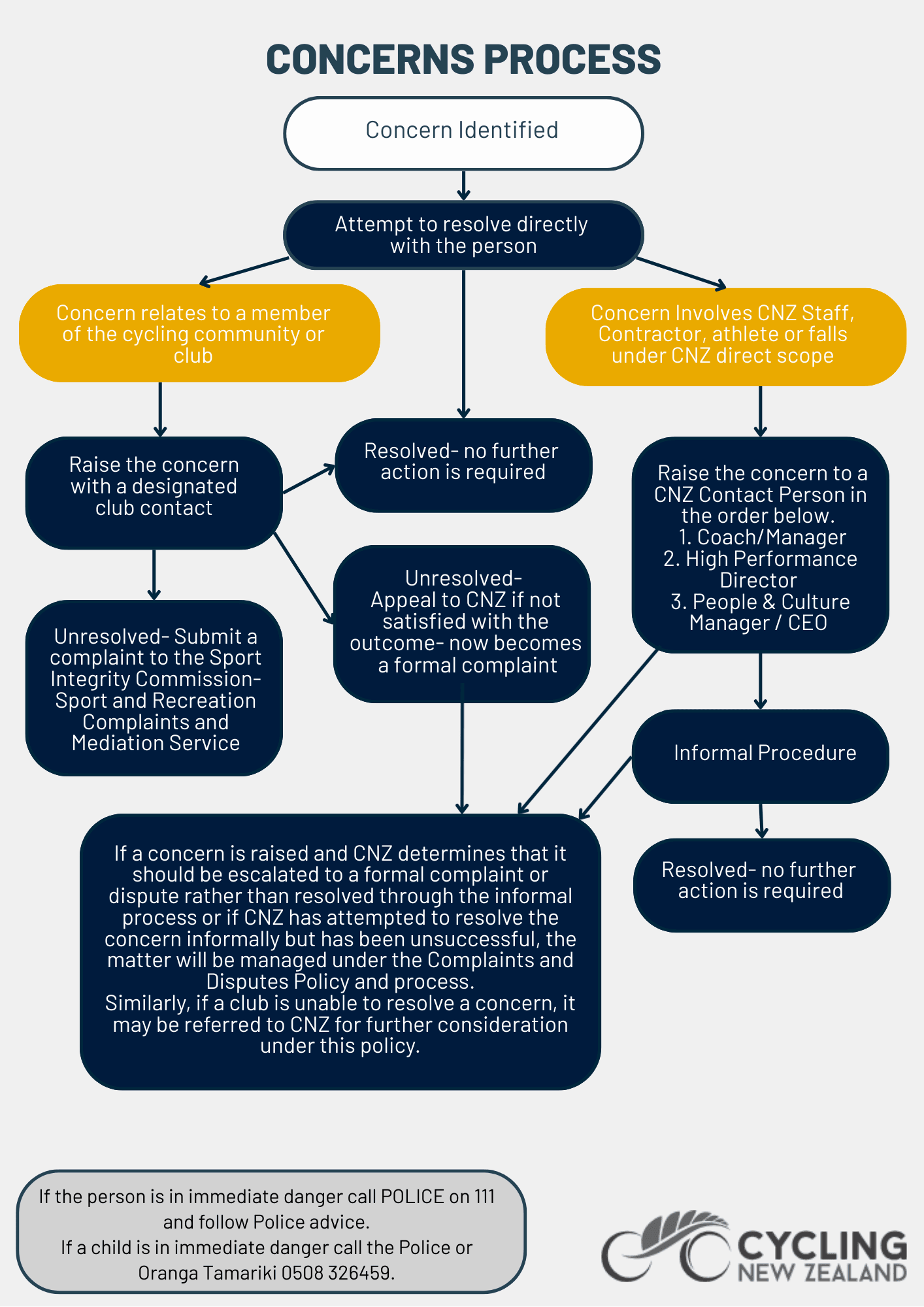
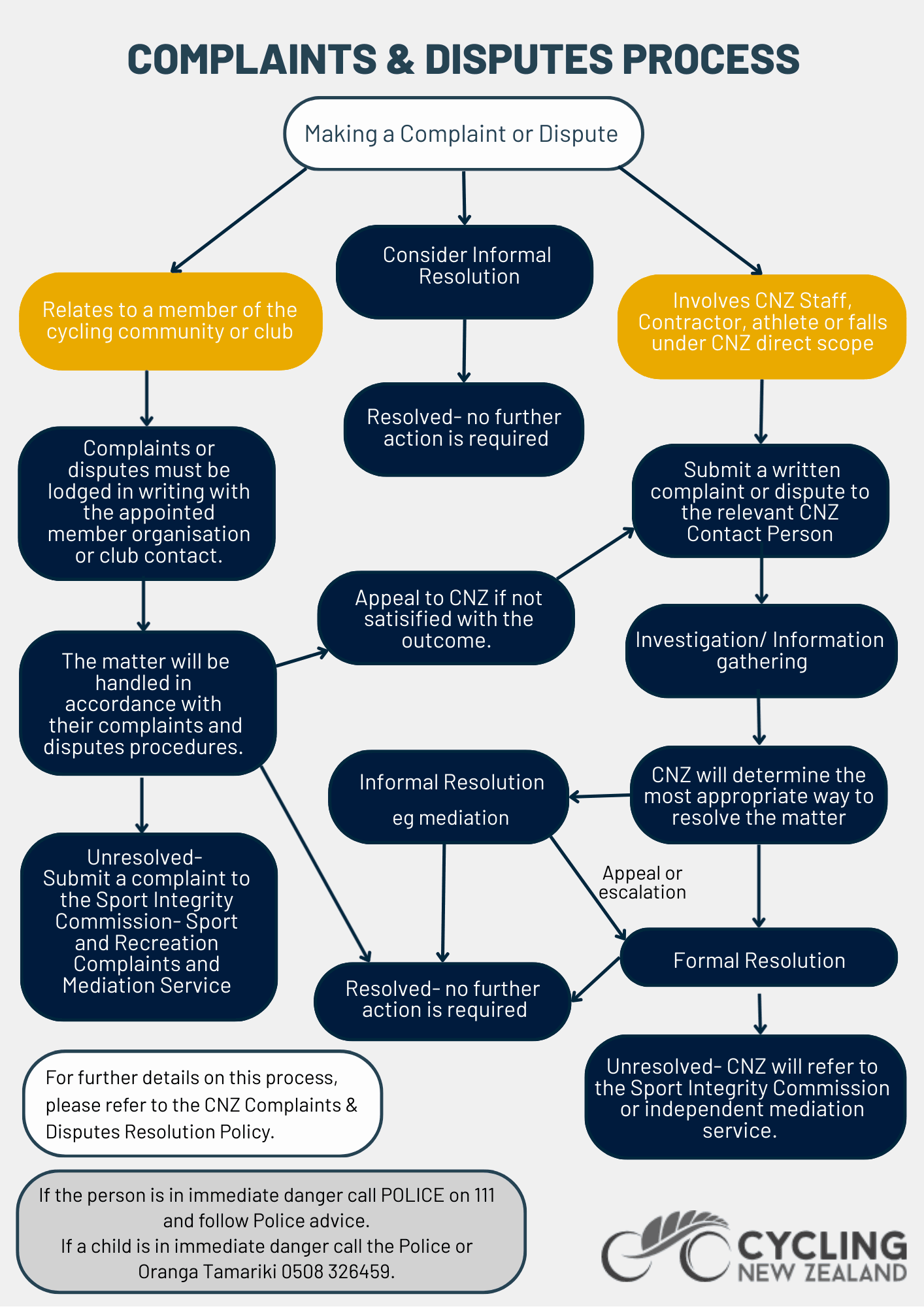
Raising A Concern or Complaint With CNZ
Concerns and Complaints relating to abuse, harassment, bullying, gambling, doping, competition fixing or Code of Conduct breaches, can be reported to CNZ via the form below.
Before submitting, we encourage you to:
Review the Cycling New Zealand Concerns and Complaints Resolution Policy.
Where appropriate, try to resolve the matter directly with the person involved.
If your complaint is not directly related to Cycling New Zealand, please raise it with your Club in the first instance.
All information submitted will be treated with respect and in line with our policies.
This form is directed to the Cycling New Zealand People and Culture Lead, who will acknowledge receipt of your concern or complaint and provide an update on next steps. Forms may be shared with another senior staff member, for oversight and to ensure continuity.
Recognising
You may identify concerns about issues that happen in CNZ, or you may hear about things that have happened outside of the organisation.
You may be concerned about someone’s physical or mental well-being, you may see signs of abuse or notice that they look distressed or unhappy, a participant may tell you about something that rings an alarm bell with you or directly disclose that they are being abused or in danger.
In individuals you may identify concerns in the forms of:
Injury
Depression
Self-Harm
Disordered eating and eating disorders
In terms of relations with others, concerns may mean:
Sexual harassment
Sexual abuse
physical abuse
forced physical exertion
emotional abuse
virtual maltreatment
neglect
bullying
doping
financial abuse
Organisationally, concerns may take place in the form of:
Abuse from spectators
Discrimination
Cultures which normalise abuse
unhealthy training environments
medical mismanagement
Systematic doping
Age Cheating
Selection process
Responding To A Disclosure
Responding to disclosures:
Do
Keep calm.
Listen- Take what the person says seriously.
Acknowledge the Disclosure- Recognise the courage it takes for someone to share their concerns. A simple acknowledgment can go a long way in making them feel heard and valued.
Let them know what you are going to do next.
Report- Let them know you need to tell someone else. Follow CNZ reporting procedures or contact the police if you think the person is at immediate risk of harm.
Report- Write down accurately what has been said.
Don't
Tell the person that you can keep it a secret. Do explain that you may need to pass the information on to keep them, or other people, safe.
Panic, overreact, be judgmental or make assumptions.
Investigate, repeatedly question or ask the individual to repeat the disclosure.
Discuss the disclosure with people who don't need to know.
It is important to remember that the welfare of the individual is of paramount concern. However, it isn’t up to you to decide whether or not a person has been abused but to report concerns appropriately by following your safeguarding adults or safeguarding children procedures.
If you think an individual is in immediate danger or discloses that they are in immediate danger, call the police.
Definitions- Concern, Complaint & Dispute
Concern
A worry or issue raised informally that may not yet amount to a breach of rules or policies.
Often raised early to flag potential risks, wellbeing issues, or minor problems.
Usually managed through early resolution: discussion, support, or monitoring, rather than formal investigation.
Complaint
A formal expression of dissatisfaction that rules, policies, standards, or expected behaviours have been breached.
More serious than a concern and requires a structured process.
Example in sport:
A rider makes a complaint that they were subjected to verbal abuse by a coach.
A parent lodges a complaint about a lack of duty of care during a camp.
Managed through a complaints and disputes resolution policy: intake, assessment, investigation, and outcome.
Dispute
A disagreement between parties about a decision, entitlement, or outcome (often rights-based).
Typically arises when someone challenges a decision that directly affects them.
Example in sport:
An athlete disputes their non-selection for a national squad.
Two clubs dispute a rider transfer or eligibility.
Managed through a disputes/appeals process or selection policy: mediation, arbitration, or tribunal.
Summary
Concern → early flag, informal, preventative.
Complaint → formal allegation of misconduct or breach.
Dispute → challenge to a decision, entitlement, or right.
Policies
Sport and Recreation Complaints and Mediation Service
The Sport and Recreation Complaints and Mediation Service (the SRCMS) is now part of the Integrity Commission. Their legal functions include providing complaints and dispute resolution processes for integrity issues in sport and recreation. This includes complaints about harmful behaviour such as bullying, sexual misconduct and racism.
Education
Other Resources
NEW- Online Complaints Handling Module
This course is designed to build confidence, clarity, and capability across Cycling New Zealand (CNZ) in responding to concerns, complaints, and disputes in a fair, consistent, and policy-aligned way. It supports people in different roles (coaches, staff, volunteers, officials, HP personnel, safeguarding leads) to understand what to do, what not to do, and when to escalate while maintaining trust, safety, and natural justice.